
What a Six-Foot Putt and a $1.3 Billion Bank Collapse can teach you about trading?
Back in 1979, Daniel Kahneman and Amos Tversky published their prospect theory, built on a carefully measured finding. They found that people do not measure a loss and a gain the same way you might think. What they found was that people naturally perceive a loss as roughly twice as significant as an equivalent gain. For example, losing $100 feels much worse than winning $100, even though they are essential the same amount of money.
This difference in this perception is what researchers call the loss-aversion coefficient (λ), and it has been rigorously tested over decades of research, consistently landing between 1.5 and 2.5, with 2.0 used as the standard reference value. In fact, Kahneman won the 2002 Nobel Prize in Economic Sciences largely on the strength of this theory, but his co-author Tversky died before he could be presented the prize, losing out on the recognition of this accolade.
But just to be clear, this theory isn't only about the phenomenon that we weigh losses greater than gains. It also shows that we reorganize our behavior around a reference point, like our current position relative to zero, rather than around the actual decision in front of us. Once that's the frame, it starts showing up in places that have nothing to do with markets at all.
The Putt that Just Hits Different
Two economists, Devin Pope and Maurice Schweitzer, analyzed more than 1.6 million competitive golf putts, laser-measured, from PGA Tour events. They isolated putts of the same length and difficulty that differed only in framing. First a putt to save par, where missing it counts as a loss relative to the hole's expected score, and second a putt for birdie, where sinking it counts as a gain.
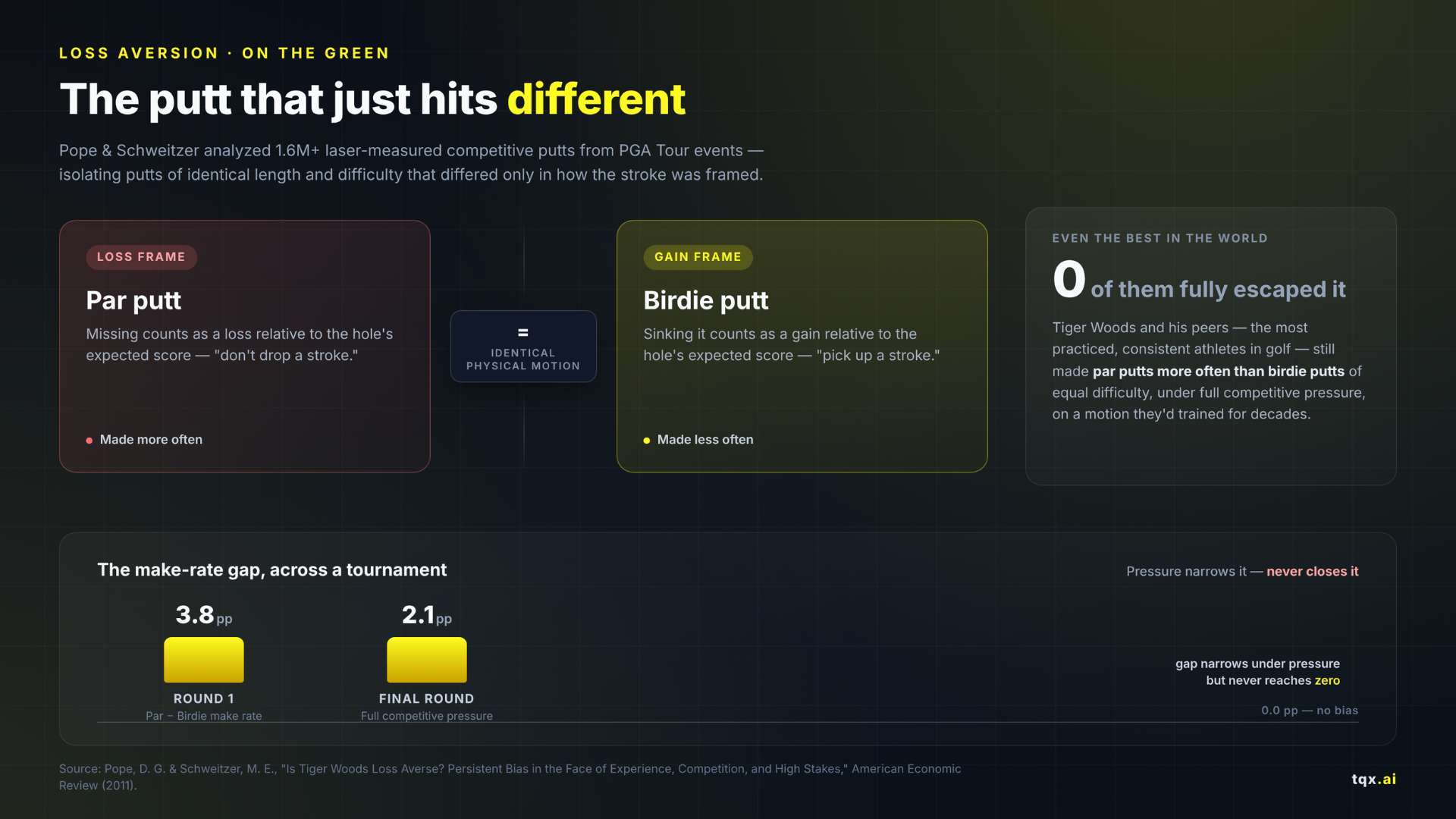
They found that even pro golfers like Tiger Woods made the par putts more often than not, with a gap of 3.8 percentage points in the first round of a tournament, narrowing to 2.1 points by the final round. This held even under full competitive pressure, with the gap never fully closed. To put that into perspective, the most practiced, consistent athlete in golf still unconsciously treats "don't lose a stroke" as a harder task than "gain a stroke," on an identical physical motion. It's this perception that sits embedded in even the most disciplined minds, despite spending most of their adult lives training against it.
How Prospect Theory Influences Your Trading Behavior
If a reference point this subtle can move a professional's hands on a six-foot putt, it's definitely going to influence the way you make trading decisions. And it shows up as at least three distinct behaviors, each with its own name and its own research to prove it.
The Disposition Effect
This describes behavior like selling winning positions earlier than planned to lock in the good feeling, or holding losing positions long past where the data would recommend exiting. Both of these decisions happen because your perception is skewered by the context of the trade you're in at that moment, and not by the rules you set in place based on sound trading practice.
The scale of this isn't guesswork. Terrance Odean tested it directly against ten thousand real brokerage accounts at a discount broker and found investors were roughly one and a half to two times more likely to sell a winning position than a losing one, even after controlling for tax effects and portfolio rebalancing. The one time he saw the pattern reverse is every December, when tax-loss selling finally gives people a good reason to realize losses on purpose. But for the rest of the year, the asymmetry runs exactly in the direction prospect theory predicts.
Myopic Loss Aversion
In 1995, Shlomo Benartzi and Richard Thaler published a paper addressing a long-standing puzzle: stocks have historically outperformed bonds by a far greater margin than any reasonable level of risk aversion should allow. So why doesn't everyone simply hold more equity? Their answer was "myopic loss aversion," which combines the same λ-weighted pain response with a short evaluation window.
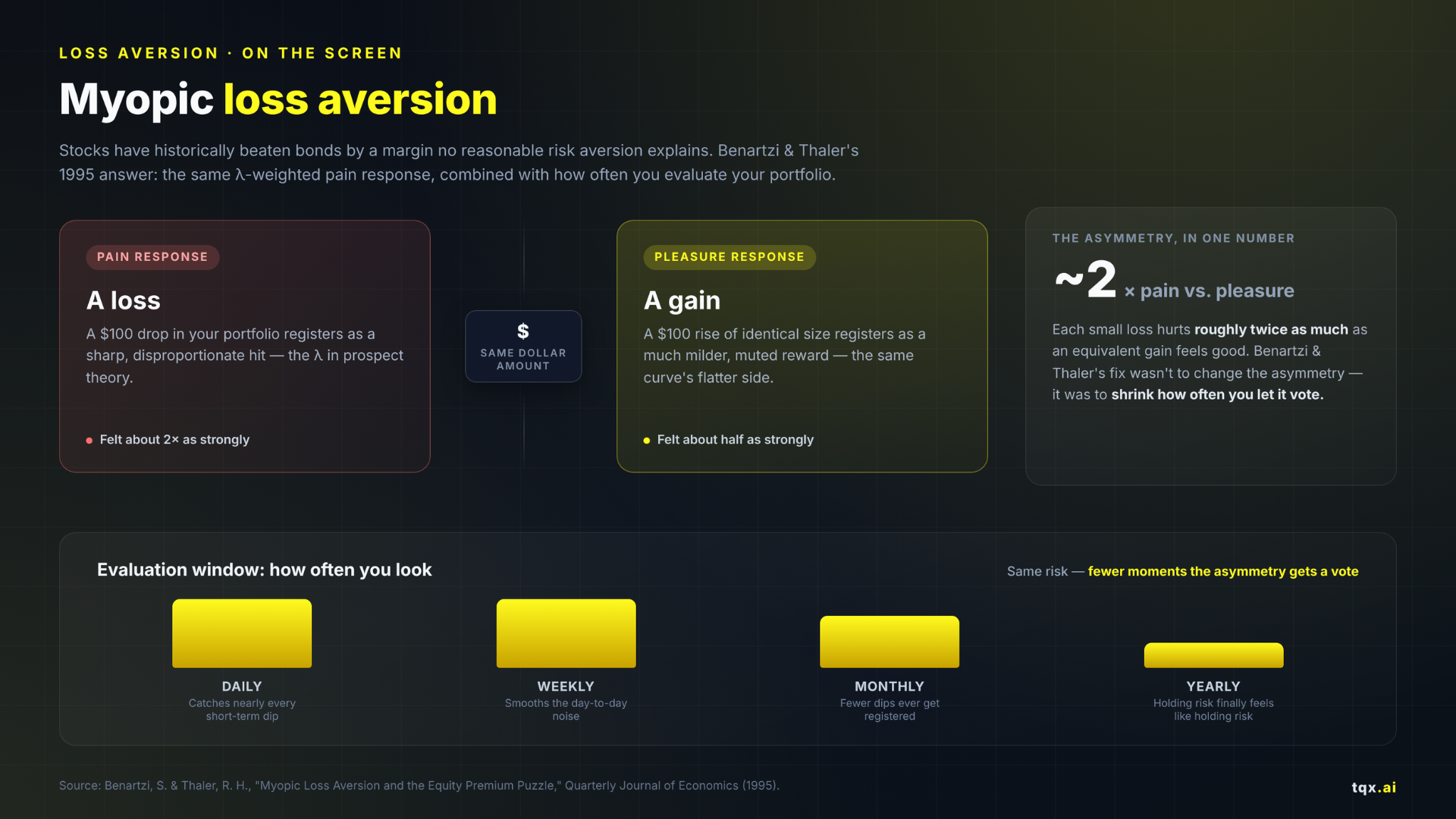
They found that investors who check their portfolio often enough will catch more of the market's short-term dips, and because each small loss hurts roughly twice as much as an equivalent gain feels good, frequently checking their portfolio makes holding risk feel far worse than it actually is. Their math implied an almost absurdly simple fix. Those investors simply needed to stop checking their portfolio so frequently. Less obsessive checking leads to a smaller sample of moments in which the asymmetry gets a vote.
Overtrading and Overconfidence
Barber and Odean's landmark study tracked 66,465 real brokerage accounts and made a finding that should turn most arguments about trading skill on their head. First, they looked at the stocks picked by the most active traders and the stocks picked by the least active traders, before costs, and found they performed almost identically. But what they found was that after costs, the active group underperformed by several points a year compared to the other group. The gap between these groups was influenced primarily by frequency and timing, not their choice of stocks.
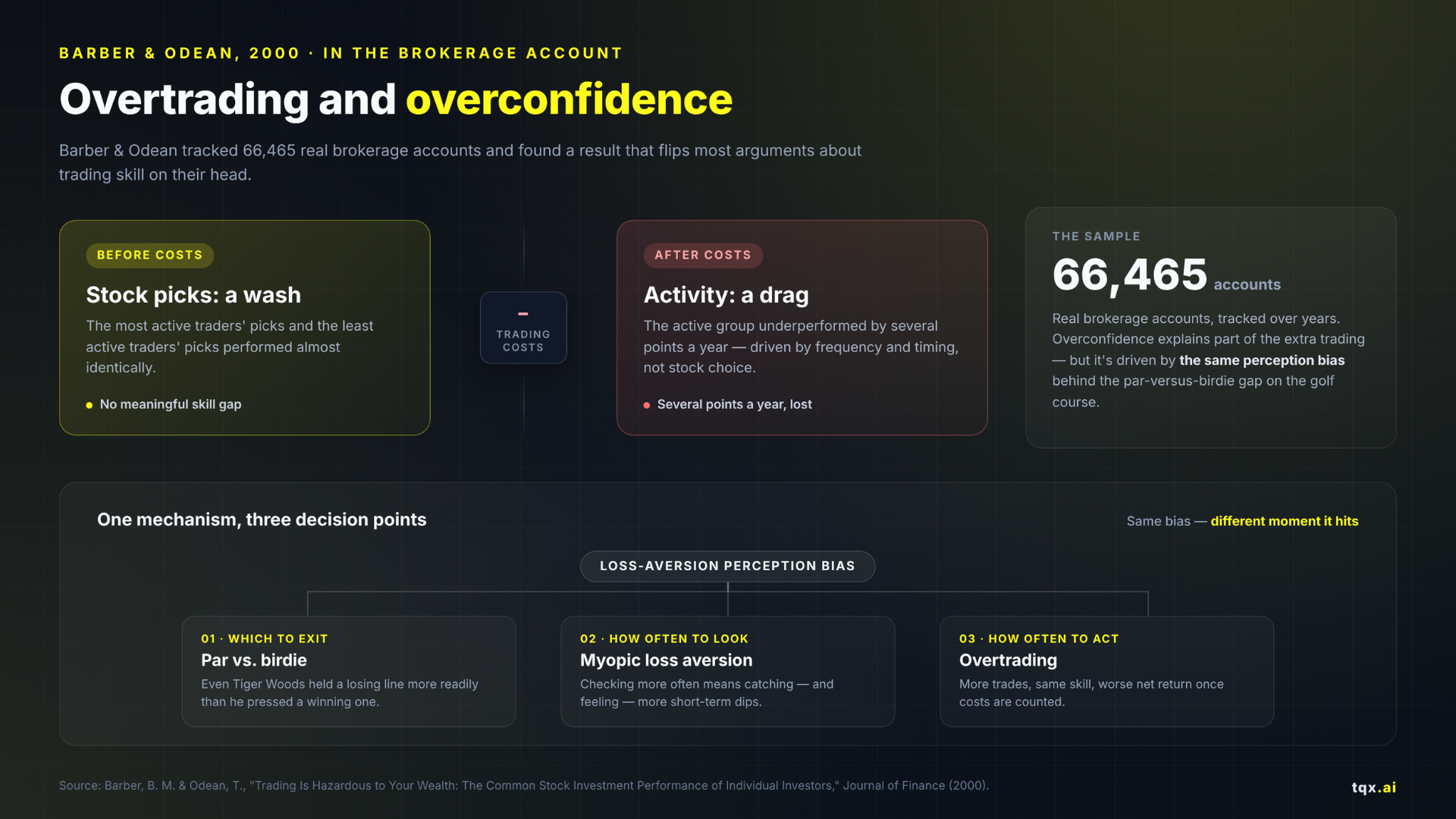
Overconfidence does explain part of that extra trading, but it's driven by the same perception bias behind the par-versus-birdie gap in the golf study. All three of these behaviors share one mechanism, influencing you at three different decision points: which position to exit, how often to look, and how often to act.
The Bank that Checked its Books too Late
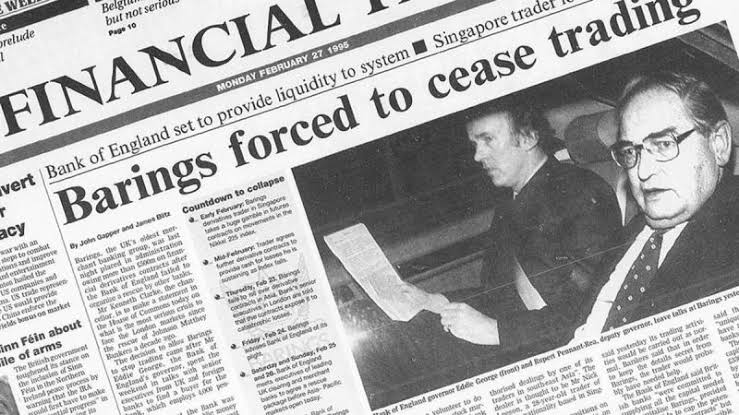
It all started around 1992, when a derivatives trader in Singapore named Nick Leeson, who was employed by Barings, had a small losing position go horribly wrong. At the time Barings was Britain's oldest merchant bank, one of the firms that financed the United States' 1803 Louisiana Purchase. When Leeson considered the losing position, he decided against simply closing it and reporting it as a manageable loss. Rather, he moved it into a secret account and started trading larger positions, hoping to recover the loss before anyone would find out. Except he didn't manage to recover the loss, only to have it spiral out of control.
In finance, that failure had a name even back then: segregation of duties. Leeson controlled both the trading desk and the back-office settlement function that was set up to independently verify his positions. Unfortunately, the check that was designed to catch exactly this kind of hidden loss was being run by the same person hiding it. An internal memo to Barings' CEO, three months before the collapse, warned that the bank's control culture was "distinctly flaky," but it was brushed aside, to the bank's own cost.
In February 1995, that hidden loss had reached an unimaginable £827 million, more than double the bank's entire capital. A single missing control cost a 233-year-old institution more than twice what it had, and with it, the institution itself.
After the collapse of Barings, the UK created the Financial Services Authority specifically to oversee this kind of risk. The Basel Committee tightened international capital and risk-management standards, while Singapore amended its Futures Trading Act to give regulators direct monitoring power over individual traders.
The Fix, Run as a Replay, Not a Slogan
The reality is you don't have a back office, or a second team checking your position against the exchange's records, to keep you from overtrading or making irrational decisions. Your only protection is the hard rules you exercise with stubborn discipline, no matter how good or bad your position looks at any one time.
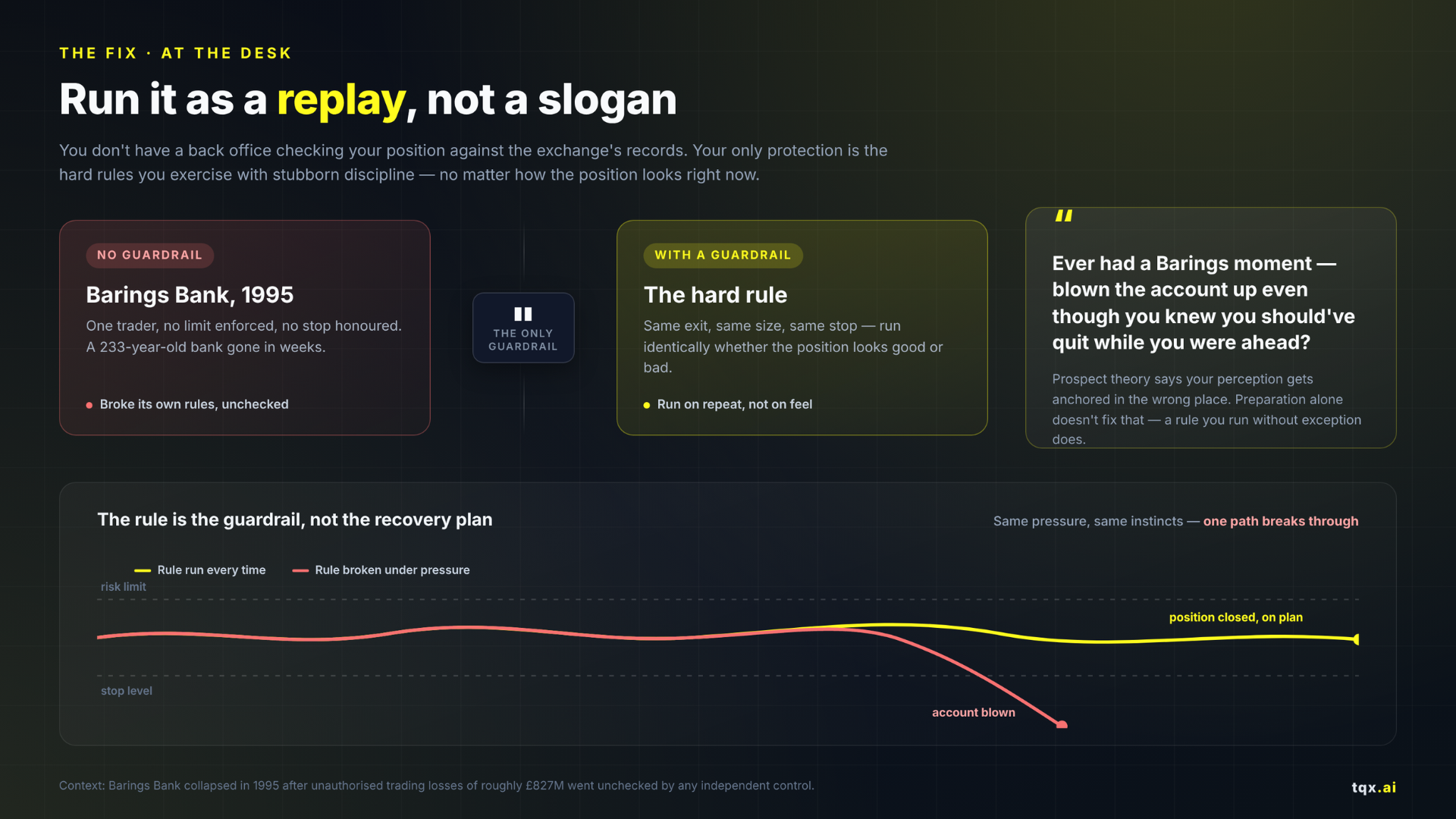
Barings' collapse is a magnified version of what can happen when you break your own rules and don't know when to stop. Human behavior under pressure can be unpredictable. Prospect theory proves your perceptions can be anchored in the wrong place when weighing a decision between a loss and a gain, and that even elite athletes' decision making is compromised despite preparation and extreme training.
That's why you need rules: they're the guardrails that protect you from irrational trades, despite knowing better.
Ever had a Barings Bank moment and blown your account up even though you knew you should quit while you were ahead?