
Why AI hasn't democratize Alpha, but synchronized It?
The half-life of a trading edge just collapsed, and almost nobody is pricing it.
In July, systematic hedge funds handed back a quarter of their year in a matter of weeks. Goldman's post-mortem didn't blame the models, but rather blamed crowding, which happens when too many managers get caught in the same trades at the same time.That same month, a screenshot went round claiming $230,605 in profit from a trading bot someone built by talking to an AI. Fifty thousand trades, sixty-three days, and no trading background. They are describing the same phenomenon, and the thing that connects them is a measured quantity that somebody put a number on nine years ago.
How Edge decay has a speed limit, and AI just removed it.
Let's start with the finding that should be better known than it is, McLean and Pontiff, in the Journal of Finance, took 97 published stock-return predictors including real, documented, academically validated anomalies and tracked what happened to each after publication:
"Portfolio returns are 26% lower out-of-sample and 58% lower post-publication… We estimate a 32% (58%–26%) lower return from publication-informed trading."
Roughly a third of a documented edge disappears for no reason other than other people knowing about it. Their conclusion: "investors learn about mispricing from academic publications", which should stop anyone building strategies with a shared tool:
"Predictor portfolios exhibit post-publication increases in correlations with other published-predictor portfolios."
But not only did the strategies weaken, they began to move together. Now here's what could be genuinely new. That decay had a speed limit, and the speed limit was human diffusion. A researcher might find an anomaly, it then goes through review, it gets published and circulated. Then practitioners read it, argue about it, build it, get it approved, deploy capital. Years would pass between discovery and crowding which is precisely why there was money in being early.Generative tooling deletes every step in that chain because there is no publication, and no diffusion.
When a model produces a credible strategy on demand, everyone who asks becomes what McLean and Pontiff call "an aware investor" who are the people competing your edge away. All this at the same moment, without any of them knowing the others exist. The lag that made being early valuable was a property of how slowly information moved between humans.But that property has been obliterated.
The claim isn't that AI-generated strategies are bad, in fact many will be perfectly sound. The claim is that the half-life of an edge has collapsed, and the thing that used to buy you time which was being one of the few who knew is no longer scarce. This is also why saying "but my strategy works" isn't a rebuttal. The strategies in McLean and Pontiff's sample worked too, that was the entry criterion.
What that looks like when it happens?
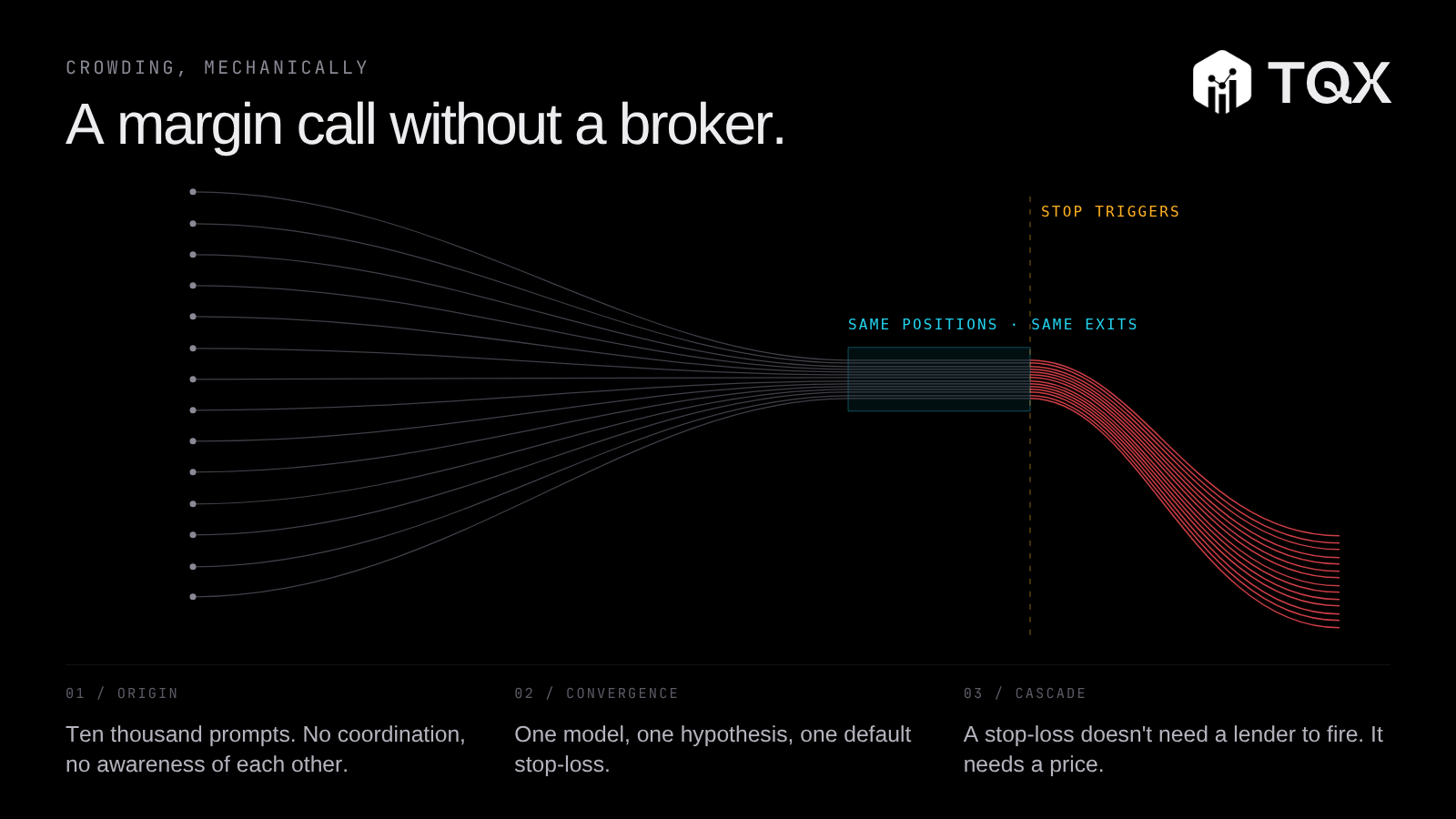
We are not speculating about the failure mode. It has happened twice in public, nineteen years apart. August 2007. Quantitative long/short equity funds suffered what Amir Khandani and Andrew Lo called "unprecedented losses." Their reconstruction: a forced liquidation somewhere in the system, and then:
"These initial losses then put pressure on a broader set of long/short and long-only equity portfolios, causing further losses by triggering stop/loss and de-leveraging policies."
Nobody colluded. No model was defective. Yet funds that had never spoken had independently arrived at similar positions and the load-bearing part similar rules about when to get out.Then in July 2026, Goldman's note, via Reuters, managers "got caught in crowded trades," with losses from "bets against some of the biggest and most crowded parts of the market." Systematic managers fell from 14.4% for the year on 22 June to 10.8%. Hedge fund leverage hit its lowest level in a year as everyone reached for the same exit.
One detail in that report deserves more attention than it got. Explaining the violence of the moves, Reuters noted "hefty levels of leverage among retail investors in Korean markets in particular amplified a lot of the share-price moves."Leveraged retail flow was named as an amplifier of institutional dislocation, and part of the transmission.
The screenshot, examined properly
A viral claim of 50,225 predictions over 63 days, a 50% win rate, and $230,605 in profit circulated as proof that AI has given retail a genuine institutional capability. But here's the detail, that claim cannot be evaluated. Not because it's false, but because the numbers given are insufficient for anyone to judge it, including the person who posted them.A win rate is meaningless without the prices paid.
On a prediction market, contracts trade between $0 and $1 and the price is the implied probability. If those contracts were bought around $0.50, then at 50,225 trials the standard error is 0.22 percentage points, a fair coin lands between 49.56% and 50.44% about 95% of the time, and a 50% result sits dead centre, which is no edge at all. But if they were bought at $0.30, a 50% win rate is an extraordinary edge, because the market priced those outcomes at 30% and the bot hit them at 50%.The same win rate, except the opposite conclusions.
The screenshot doesn't say which. It also doesn't give stake sizes, maximum drawdown, or how much capital was at risk to earn roughly $4.59 per trade across some 797 trades a day.This isn't a takedown of the trader, it's a demonstration of a habit. The screenshot does what every crowded trade in history has done in the past, which is, present a result without the context required to know whether it can be repeated, or for other people to copy it.
From "what to buy" to "what rule to run"
A capability is not an edge. Edge is a differential, it exists only relative to what everyone else is doing, which is why the same strategy run by one person and by a hundred thousand is not the same strategy.The obvious objection, and it's a good one is that retail was never uncorrelated. Barber, Odean and Zhu went through the trading records of hundreds of thousands of ordinary investors at two brokers and found that individuals' buying and selling is "highly correlated and persistent."
People pile into the same things at the same time, and keep doing it. And it isn't because they're following the institutions. It's in their own habits of chasing whatever just went up, refusing to sell losers, and buying whatever happens to be busy. Anyone who watched GameStop knows this.So what has AI changed?The mechanism, the speed, and most importantly the domain. Retail used to correlate on what to buy, but is now correlating on what rule to run.
That distinction is the whole thing. Attention-herding puts a thousand people into the same stock. They'll leave at a thousand different moments for a thousand different reasons. Model-herding puts those thousand people into the same strategy, the same entries, the same exits, and the same stop-losses.And a stop-loss is a forced exit you impose on yourself. Khandani and Lo's cascade came from "triggering stop/loss and de-leveraging policies". A stop-loss doesn't need a lender to fire. It needs a price. An unlevered bot with a mechanical stop is running a self-executing liquidation trigger, and if ten thousand bots share a similar one, that is a margin call without a broker.
Correlated positions are a return problem. Correlated exit rules are a market-structure problem and the retail wave is quietly building both, while nobody is counting the second one.None of this is a fringe worry. The Financial Stability Board's 2024 report names market correlations among four AI vulnerabilities that "stand out for their potential to increase systemic risk," and the BIS puts the mechanism in eight words: "Market correlations, eg widespread use of similar AI models and training data."
What this means for how you actually build a Strategy?
If model output converges, whatever edge remains has to live upstream of the model. It lives in the hypothesis, which is rarely the question a default prompt produces. It lives in the data you chose, particularly if it isn't in everyone else's training set. And it lives in the constraints you impose because you have domain knowledge the market doesn't.None of that is generated by the model, but all of this is supplied by you.
This is what we mean when we say AI is not the researcher, but rather the laboratory. A lab is enormously valuable because it compresses months into hours, runs tests you'd never have had time for, catches errors you'd have made by hand. But what it does not do is decide what's worth investigating. Outsource that and you've outsourced the only part that was ever differentiated.Two things follow, and they're worth more than the rest of this article.
Your exit is your edge now. If shared exit rules turn crowding into cascade, the most valuable non-obvious thing you own isn't your entry signal. Every model will suggest a similar stop. The question is whether you have a reason for yours that isn't simply the default.Friction is a feature. McLean and Pontiff found the surviving returns concentrated "in stocks with high idiosyncratic risk and low liquidity", the places that are expensive to arbitrage. The edges that survive contact with a crowd are the ones a crowd finds costly to reach.
The uncomfortable implication, stated plainly: the cheaper it becomes to generate a strategy, the more weight falls on the human judgment about which strategy to generate.The question isn't whether AI can build you a trading strategy. It obviously can, faster than you can, and often better. The question is whether it just built the same one for everybody else and whether you'd know.
ABOUT TQX

We provide you with the infrastructure previously only available to large hedge funds and trading desks to build institutional grade trading strategies using natural language, and no code.Tired of trading on hunches, gut feelings and random signals?
Level up your trading today with TQX : www.tqx.ai